Insight
AI Agents for Business: Where They Hold Up
Where AI agents earn their place in a business, where they fail, and how to deploy one safely with narrow scope, approvals and logging.
October 19, 2026 · Cogya · 8 min read
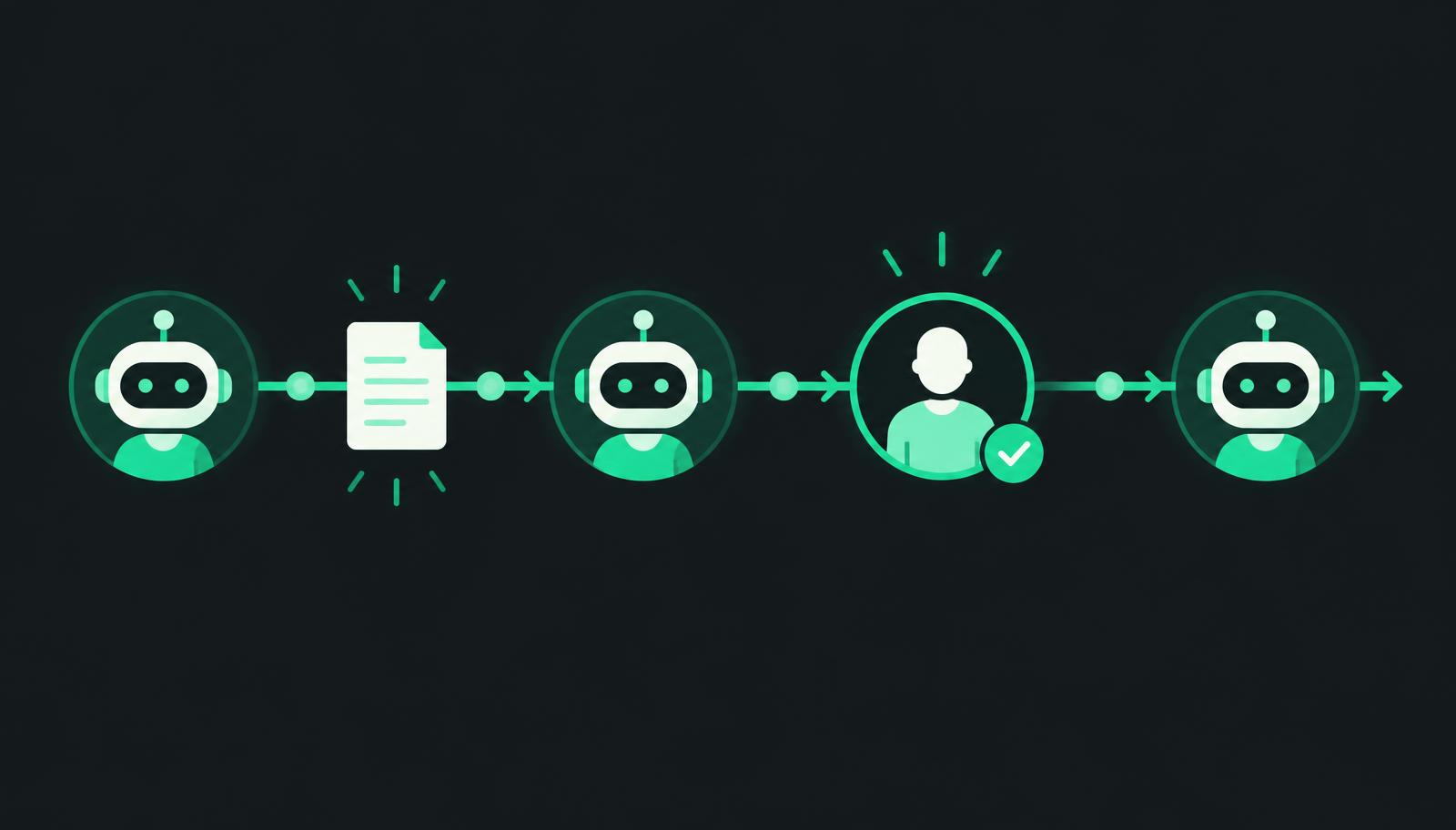
Most writing about AI agents for business describes a digital employee: give it a goal, connect it to your tools, and let it work. In production, the agents that hold up look much less like employees and much more like a well-defined step in a process, with a clear input, a narrow job, and a person who signs off on anything that matters.
What is an AI agent for business?
An AI agent is software that reads a situation, decides what to do next and takes an action in another system, such as drafting a reply, updating a record or routing a case. What separates it from a chatbot is the action. What separates a useful one from a demo is everything around the action: what it is allowed to touch, when it must stop and ask, and how you know it did the right thing.
Where AI agents hold up in a business
Across the systems we build, agents earn their place in three shapes of work.
1. Turning documents into decisions
Quotes, RFQs, invoices and supplier price lists arrive in every format. An agent reads them, extracts the fields, checks them against rules and prepares the next step. In a healthcare procurement and bid management build for a company operating across the US and Saudi Arabia, RFQ response time went from 24–48 hours to 1–2 hours, and pricing errors fell by 70%. The agent did not replace the bid team. It removed the reading and re-keying that kept them from bidding.
2. Matching and filtering at volume
When the job is comparing many items against criteria, agents are fast enough to change what is possible. In an AI recruitment build for a France-based cybersecurity recruitment agency, candidate matching and filtering went from around five days to three hours. Recruiters kept the final submission decision. The agent made it possible to act while the candidate was still on the market.
3. Applying expert judgment consistently
The hardest and most valuable shape is encoding how an expert reasons. In the ROI Monitor build, fifteen years of a causal marketing-attribution methodology became a working system, and attribution analysis went from four days to seconds. This only works when the expert is involved in the build and the reasoning can be written down and tested.
Where AI agents fail
- Open-ended goals. "Grow our pipeline" is not a job an agent can be checked against. "Draft a first reply to every inbound RFQ within an hour" is.
- Too many permissions too early. An agent that can send, pay or delete on day one turns small mistakes into expensive ones. Start with draft-only access.
- No exception path. Every real process has cases that do not fit. If the agent has nowhere to send them, it guesses.
- No record of what it did. If you cannot see why an agent took an action, you cannot fix it or trust it.
How to deploy an AI agent safely
- Pick one process, not a department. Choose the step with the highest daily volume and the clearest right answer. Our guide on which processes suit AI agents goes deeper.
- Measure it before you build. Record how long the step takes and how often it is redone. Without that baseline you cannot measure the return honestly.
- Start in draft mode. The agent prepares, a person approves. Widen its permissions only when its approved-as-is rate is high and stable.
- Design the escalation first. Decide which cases go to a person, and make sure someone owns that queue.
- Log every decision. Keep the input, the output and the reason, so mistakes can be traced and corrected.
Agents, automations and integrations
Not every problem needs an agent. If the step follows fixed rules on clean data, a plain automation is cheaper and more predictable. If the problem is that two systems do not talk to each other, you need API and data integration first. Agents are worth their cost where inputs are messy and some judgment is needed. Our pillar page explains what it takes to make an AI automation work.
How to start
Run an AI readiness assessment on one or two candidate processes. If you want outside help, the first thing to buy from an AI automation consultant is a fixed-scope diagnosis, not a build. Then put one agent into production, in draft mode, and measure it honestly for a month before you widen it.
The short version
AI agents work in business when they have a narrow job, limited permissions, a path for exceptions and a record of every decision. Start with one high-volume, document-heavy step, keep a person on approval, and expand only on evidence.