Insight
AI Readiness Assessment: Are You Actually Ready for AI?
Most AI readiness assessments score the company. The useful ones score a single process. Here is what to check, what to ignore, and how to tell whether you are ready to build.
October 14, 2026 · Cogya · 8 min read
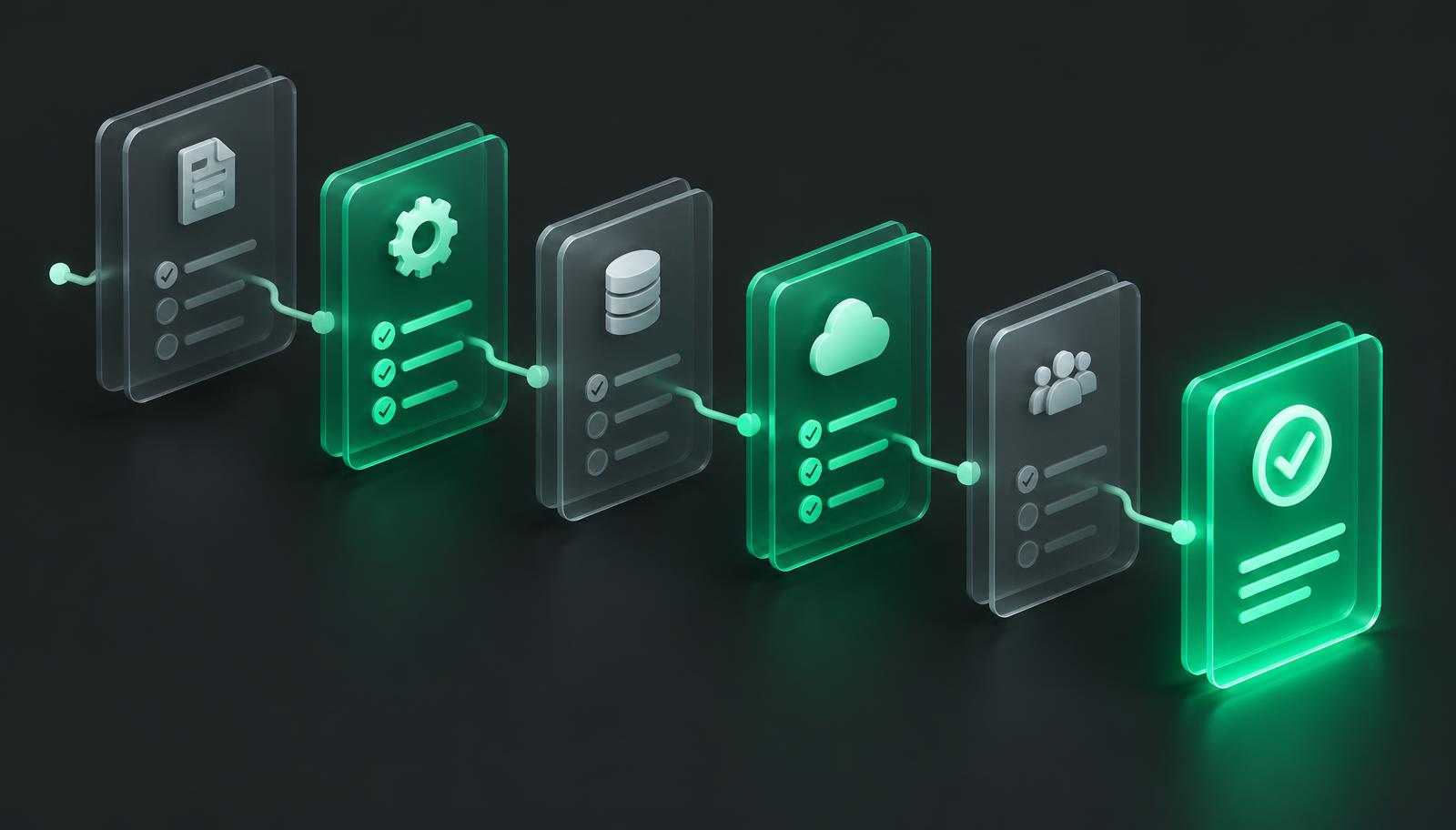
Most AI readiness assessments score the whole company: data maturity, culture, leadership buy-in, a radar chart with five axes. The result is usually a number between two and four out of five, and almost nobody can act on it. Companies are not ready or unready for AI. Processes are.
What is an AI readiness assessment?
An AI readiness assessment is a structured check of whether a specific business process can be handed, in part, to an AI system, and what has to be true first. Done well, it ends with a decision: build now, fix something first, or leave this process alone. Done badly, it ends with a maturity score and a list of initiatives.
The difference matters because the expensive mistakes in AI projects are rarely technical. They are choosing a process that was never a good candidate, or choosing a good one without knowing what it costs today.
Why company-wide readiness scores mislead
A company with messy data in general can still have one process with clean, consistent inputs that is ready tomorrow. A company with a modern data platform can still have its most painful process living in email attachments and one person's memory. Averaging those into a single score hides both facts.
The scores also tend to reward the wrong things. Having a data strategy document, an AI policy and a steering committee raises the score; none of them makes a supplier quote easier to read or a candidate profile faster to format.
The five checks that actually predict success
Run these against one process at a time. If a process fails one, that is not a no; it tells you what to fix first.
1. Is the step frequent enough to matter?
AI systems pay back on volume. A step that happens twice a month will rarely justify a build, however tedious it is. A step that happens dozens of times a day almost always deserves a look. Count it before you discuss it.
2. Do you know what it costs today?
Write down how long the step takes, how often it runs and how often it is redone. If nobody can answer, the first piece of work is measurement, not a model. Without a before-number there is no honest way to measure the return afterwards.
3. Are the inputs reachable?
The system needs to see what the person sees: the emails, PDFs, spreadsheets or system records. Inputs do not need to be tidy. They need to be accessible, either through an export, an inbox or an integration. Locked inside a tool with no export is a real blocker; messy is not.
4. Can someone say what a good output looks like?
If two experienced people would disagree about the right answer, the system will not settle the argument for you. Readiness means someone can review ten outputs and say which are right, and why. That reviewer becomes the validation harness for everything that follows.
5. Is there a place for exceptions to go?
Every working system hands some cases back to a person. Readiness means knowing who receives them and how fast. A process with no owner for exceptions will quietly accumulate them until people stop trusting the system.
What does not need to be ready
- A company-wide data platform. One reachable input source per process is enough to start.
- An AI strategy. A strategy written before the first working system is mostly guesswork. Write it after the first one runs.
- A dedicated AI team. You need one process owner and one reviewer, not a department.
- Perfect documentation. Most processes are undocumented. Mapping the step is part of the assessment, not a precondition.
Which processes usually pass first
The same three patterns pass most often, and they line up with where the returns usually are:
- Document-to-data. Reading quotes, invoices, CVs or forms and turning them into structured records. At a healthcare procurement organisation Cogya worked with, RFQ response time went from 24–48 hours to 1–2 hours. See the case study.
- Matching and filtering at volume. Comparing many items against criteria. At a France-based cybersecurity recruitment agency, candidate matching and filtering dropped from 3–5 days to 2–3 hours. See the case study.
- Encoding expert judgment. Turning a specialist method into a repeatable system. This is the hardest of the three and usually comes later, as it did for ROI Monitor.
How to run an assessment in practice
Pick the three processes people complain about most. For each, spend an hour with the person who does it, watching rather than interviewing. Count frequency, time per run and rework. Collect five real examples of the inputs and the outputs. Then run the five checks above.
You will usually end with one process that passes, one that needs a measurement or access fix, and one that should be left alone. That is a better outcome than a score, because it tells you what to do on Monday.
If you would rather have someone outside the business do this, that is the job a fixed-scope diagnosis from an AI automation consultant is for. The output should be the same: a named process, its current cost, and a clear build, fix or leave decision.
The honest summary
Readiness is a property of a process, not a company. Check frequency, current cost, reachable inputs, a definition of good and a home for exceptions. If one process passes all five, you are ready, whatever your maturity score says. For what the build itself has to do once you start, read what it takes to make an AI automation work.