Insight
Where Should a Business Actually Use AI? Start With the Bottleneck, Not the Tool
Where should a business actually use AI? Learn how to identify operational bottlenecks where custom AI systems, AI integration and automation can create measurable business value.
August 25, 2026 · Cogya
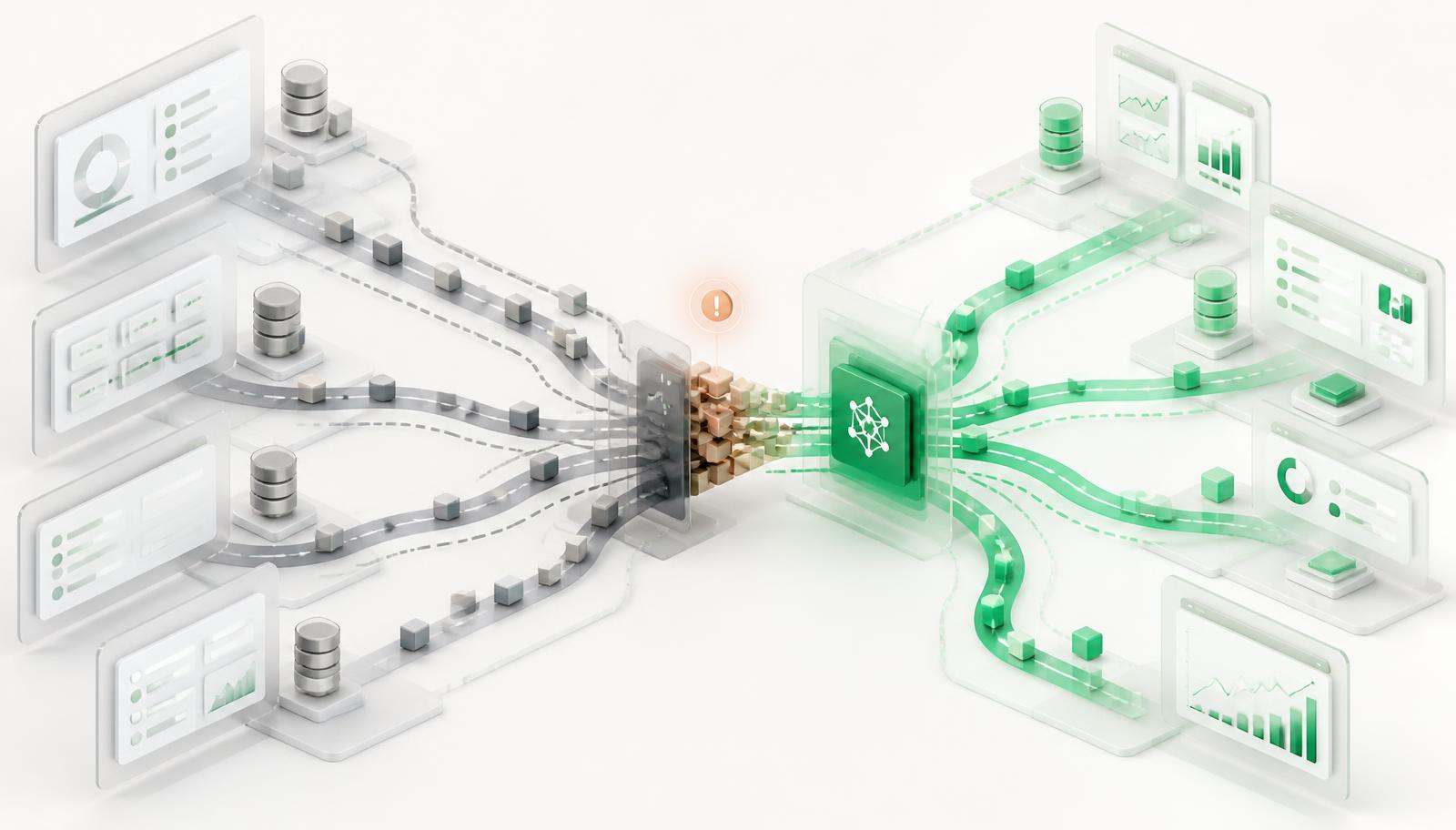
Artificial intelligence is becoming easier to access.
That does not mean every business problem needs AI.
Companies are experimenting with chatbots, copilots, AI agents and automation tools, but the more important question is often being skipped:
Where is the business actually losing time, capacity, accuracy or decision speed?
That is where we believe AI conversations should start.
Not with the model.
Not with the latest tool.
Not with, “How can we use AI?”
Start with the bottleneck.
Most Companies Don't Have an AI Problem
They have operational problems.
Information is spread across an ERP, CRM, spreadsheets, documents and email.
Employees copy data from one system into another.
Experienced people spend hours reviewing documents before making decisions.
Teams prepare the same reports manually every week.
Important business knowledge exists primarily in the heads of a few employees.
A bid that should take hours takes days.
A supplier file arrives in a different format every time.
A decision depends on someone finding information across ten documents.
These are not fundamentally AI problems.
They are business bottlenecks.
Artificial intelligence becomes valuable when it can help remove or reduce those bottlenecks in a way that creates measurable business value.
What Is an Operational Bottleneck?
An operational bottleneck is a point in the business where work slows down, requires excessive manual effort, creates avoidable errors or limits how much the organization can handle.
Sometimes the bottleneck is obvious.
Other times, it has become so normal that nobody questions it anymore.
“We've always done it that way.”
One question we often find useful is:
Where are your people still acting as the connection between two systems, documents or departments?
That question can expose surprisingly valuable AI opportunities.
An employee may be taking information from an email, interpreting it, checking a spreadsheet, comparing it with ERP data, applying business knowledge and then entering a result somewhere else.
What looks like one task may actually contain:
data extraction + interpretation + business rules + decision-making + system integration + human review.
That is exactly the type of environment where a properly designed AI system may create value.
5 Signs You've Found a Good AI Opportunity
1. People Are Manually Connecting Systems
Imagine an employee receives information by email, checks an Excel file, looks something up in the ERP and then updates the CRM.
None of those systems may be broken.
The problem is that a person has become the integration layer between them.
AI integration can help connect information across:
ERP systems
CRM platforms
databases
spreadsheets
documents
email
internal applications
legacy software
The goal is not necessarily to replace those systems.
Often, the better approach is to create an intelligence layer around the technology the business already uses.
2. Decisions Require Reviewing Large Amounts of Information
Many business decisions are slowed by the amount of information people must process first.
A recruiter may need to review hundreds of candidate profiles.
A procurement team may compare supplier quotations, RFP requirements, product specifications and historical pricing.
A construction company may review bid documents, drawings, supplier quotes and project requirements before preparing an estimate.
A marketing team may need to connect customer behavior, campaign performance and financial results.
These situations are well suited to AI because the system can help:
Read → Structure → Compare → Analyze → Recommend
The human can then focus on judgment rather than information processing.
3. Valuable Knowledge Lives in People's Heads
Some of the most valuable intellectual property inside a business may never have been documented formally.
It might belong to:
a founder who knows how to price complex deals
an estimator who can recognize risk in a project
a procurement expert who knows which supplier to trust
a recruiter who knows what separates a strong candidate from an average one
an executive who has developed a proprietary methodology over decades
That expertise becomes a bottleneck when the business cannot operate at the same level without that person.
A custom AI system can help structure parts of that expertise into:
business logic
decision criteria
knowledge systems
recommendation engines
analysis frameworks
AI-assisted decision support
The objective is not to replace expert judgment.
It is to make valuable business knowledge more structured, accessible and scalable.
4. A Repetitive Process Takes Hours or Days
Not every repetitive task should become an AI project.
Some problems can be solved with a simple rule, integration or conventional automation.
But AI becomes particularly useful when repetitive work also requires some level of interpretation.
Examples include:
extracting information from documents
matching candidates to job requirements
comparing supplier quotations
classifying incoming requests
evaluating customer feedback
preparing estimates
generating client-ready documents
analyzing historical outcomes
identifying exceptions
recommending next actions
When the work combines repetition with interpretation, AI can often reduce the amount of manual effort significantly.
5. Growth Requires More People Just to Process More Work
This is one of the clearest signals.
A company wins more customers.
Orders increase.
More RFQs arrive.
More documents need to be reviewed.
More reports need to be prepared.
The business grows—but operational headcount has to grow almost proportionally just to process the additional information.
That can limit scalability.
A well-designed AI system can increase operational capacity by taking on parts of the information-processing workload while leaving important decisions with people.
The goal is not simply:
“How many people can AI replace?”
A better question is:
How much more can the existing team handle if unnecessary manual work is removed?
What Does a Custom AI System Actually Look Like?
Many business leaders still associate AI with a chatbot.
Chatbots can be useful.
But a custom AI system can be much broader.
A custom AI system is a business-specific application that combines artificial intelligence with company data, business rules, existing systems and human decision-making to solve a defined operational problem.
A typical architecture might look like this:
Business Data + Documents + ERP + CRM + Business Knowledge
↓
AI Engines + Agents + Business Logic + Integrations
↓
Human Review + Decisions + System Updates + Business Actions
The user may never even interact with a chatbot.
The AI might work behind the scenes to:
read incoming documents
structure information
compare records
rank options
identify exceptions
calculate estimates
recommend actions
generate outputs
update business systems
coordinate multiple AI agents
The interface should follow the business problem—not the current AI trend.
AI Automation vs. AI Integration vs. Custom AI Systems
These terms are often used interchangeably, but they describe different levels of implementation.
AI Automation
AI automation uses artificial intelligence to accelerate or perform a defined task.
Examples include:
extracting information from invoices
categorizing customer requests
drafting summaries
generating reports
It can be very valuable when the problem is narrow and well defined.
AI Integration
AI integration connects AI capabilities with existing business technology.
For example:
AI + ERP
AI + CRM
AI + database
AI + document repository
AI + legacy application
The goal is to make intelligence available inside the systems where the business already operates.
Custom AI Systems
A custom AI system can combine automation, integrations, AI engines, agents, business rules, interfaces and human oversight around a larger operational problem.
For example:
Incoming RFQ
→ AI extracts requirements
→ supplier data is retrieved
→ pricing is compared
→ exceptions are identified
→ a quotation is prepared
→ a human reviews it
→ the approved response is sent
The value comes from the complete system, not one isolated AI feature.
What AI Opportunities Look Like in Real Businesses
The technology may be similar across industries.
The business problem is not.
Distribution, Wholesale & Import
A distributor receives supplier files in different formats.
Employees manually clean the information, map fields, validate product data and prepare it for the ERP.
A possible AI system could connect:
Supplier Data → AI Structuring → Validation → ERP-Ready Data → Human Review
The result is less manual re-entry and faster processing of supplier information.
Logistics & Operational Services
Orders, warehouses, dispatch teams, drivers and customers may operate across different systems and communication channels.
Exceptions often require people to manually coordinate information between everyone involved.
A custom AI system could connect:
Orders + Warehouse Data + Driver Information + Customer Requests
↓
AI Coordination & Exception Intelligence
↓
Human Decision + System Action + Customer Update
The opportunity is not simply “automate logistics.”
It is to reduce the coordination bottlenecks that consume operational capacity.
Construction & Project Operations
Bid preparation can require teams to review:
RFPs
project documents
technical specifications
supplier quotations
pricing
estimates
historical projects
AI can help structure this information before the commercial team makes the final decision.
A possible system:
Bid Documents → Requirement Extraction → Supplier Pricing → Estimate Support → Proposal Preparation → Human Approval
Recruitment
Recruiters may spend significant time collecting profiles, comparing qualifications, ranking candidates, anonymizing information and preparing client submissions.
AI can support:
Candidate Data → Matching → Ranking → Anonymization → Client-Ready Profile
Recruiters remain responsible for evaluating candidates and deciding who should be submitted.
AI accelerates the work around that decision.
When AI Is Probably Not the Answer
A strong AI strategy also requires knowing when not to use AI.
AI may not be the right investment when:
the business problem has not been clearly defined
the process happens only occasionally
there is no usable data or information
a simple integration or software rule could solve the problem
the expected business value is too small
the company primarily wants AI because competitors are talking about it
Sometimes the right solution is AI.
Sometimes it is automation.
Sometimes it is integration.
Sometimes it is fixing the underlying process.
The objective should never be to put AI everywhere.
The objective is to use intelligence where it materially improves how the business operates.
How to Evaluate an AI Opportunity
Before selecting a model or vendor, define seven things.
1. Business Problem
What is taking too long, creating errors or limiting capacity?
2. People
Who performs the work?
Who makes the final decision?
3. Data
What information is required?
Is it structured, unstructured or spread across multiple sources?
4. Systems
Where does the information currently live?
ERP? CRM? Documents? Email? Databases?
5. AI Opportunity
What could AI realistically:
understand, structure, compare, analyze, recommend or generate?
6. Human Oversight
Where does a person still need to:
review, approve, validate, add context or handle an exception?
7. Business Value
What should improve?
time saved
errors reduced
faster decisions
higher capacity
lower operating cost
better customer response
more revenue opportunities
If the expected outcome cannot be defined, the AI project probably isn't ready yet.
Start With the Business Case
This is why Cogya uses the AI Canvas before jumping directly into implementation.
The AI Canvas connects:
Business Problem
People
Data
Systems
AI Opportunity
Human Oversight
Expected Business Value
It forces the conversation away from:
“Which AI model should we use?”
and toward:
“What should become measurably better inside the business?”
The technology decision comes after that.
From AI Experimentation to AI That Actually Works
The barrier to experimenting with artificial intelligence has fallen dramatically.
Almost any company can open an AI tool today.
That is not the same as integrating AI into the business.
Production AI requires understanding how:
people + data + systems + business knowledge + AI
work together.
That might result in:
a custom AI application
an AI engine
an intelligent decision system
AI agents
an orchestration layer
an ERP or CRM integration
or a combination of several of them
The architecture should follow the problem.
Not the other way around.
The Business Problem Comes First
AI transformation should not begin by choosing a model.
It should begin by finding where the business is losing time, information, accuracy or capacity.
Once that bottleneck is understood, the technology becomes a design decision.
Sometimes the answer will be an AI engine.
Sometimes an agent.
Sometimes an integration.
Sometimes a custom AI system.
And sometimes AI will not be the best answer at all.
That is a healthy outcome too.
Because the goal isn't to use more AI.